
By Aaron Miller-
The United States has carried out one of its most daring combat search-and-rescue operations in recent history, extracting a wounded service member from deep inside Iranian territory under heavy fire.
The mission, involving elite special forces, aircraft operating in hostile airspace, and a covert intelligence campaign, underscores both the intensity of the ongoing war and the lengths to which the U.S. military will go to recover its personnel.

AD: Capeesh Restaurant
The rescue followed the downing of an American F-15E fighter jet over southwestern Iran, an incident that left two crew members stranded behind enemy lines. While one was recovered quickly, the second a weapons systems officer and senior-ranking colonel remained missing for nearly two days, sparking a complex and high-risk recovery effort that unfolded across mountainous terrain.
The missing airman’s ordeal began after ejecting from the stricken aircraft and landing in a remote mountainous region. Injured and alone, he reportedly climbed a steep ridge at one point reaching elevations of around 7,000 feet to evade Iranian forces and local militias searching for him.
Iranian media amplified the urgency of the situation by broadcasting calls for civilians to locate the downed American, even offering incentives for his capture. This transformed the rescue into a race against time, as U.S. officials feared the pilot could be found by hostile forces first.

AD: Oysterian Sea Food Restaurant And Bar
The Central Intelligence Agency reportedly launched a deception campaign, spreading false information within Iran suggesting the airman had already been recovered and was being moved out of the country. The tactic bought critical time, allowing U.S. forces to narrow down his location using intelligence assets and emergency beacon signals.
Meanwhile, American aircraft conducted sweeping search operations across multiple provinces, flying low over rugged terrain despite the risk of anti-aircraft fire. Several helicopters involved in the search were struck by ground fire, and some personnel were injured, though all ultimately returned safely.
The broader conflict has heightened these dangers significantly. The downing of the F-15 marked one of the first confirmed instances of a U.S. crewed aircraft being shot down over Iranian territory during the current war, illustrating a shift in the conflict’s intensity and the vulnerability of even advanced military platforms.
Once the airman’s position was confirmed, the U.S. launched a full-scale extraction operation involving an estimated 200 special operations personnel, supported by dozens of aircraft, drones, and intelligence assets. The mission unfolded under cover of both air support and strategic deception, culminating in a high-risk insertion into hostile territory.
While rescue teams approached the mountainous hideout, they encountered resistance. Reports indicate that firefights broke out between U.S. forces and Iranian units or affiliated fighters, with aircraft providing covering fire to suppress enemy positions.
Despite the intensity of the engagement, U.S. forces successfully reached the wounded officer, stabilised him, and evacuated him from the area. The entire operation, described by officials as akin to “finding a needle in a haystack,” required precise coordination between ground teams, pilots, and intelligence operatives.
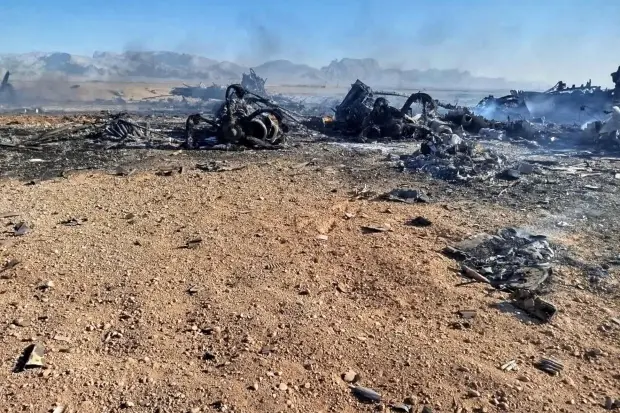
However, the mission came at a material cost. U.S. forces were forced to destroy several of their own aircraft including transport planes and possibly helicopters after they became inoperable or risked capture on the ground. Iranian officials have claimed they shot down multiple U.S. aircraft during the operation, though these claims remain unverified.
Images released by Iranian media appeared to show charred wreckage scattered near an improvised airstrip, highlighting the tightened of the confrontation and the risks involved in operating deep inside enemy territory.
President Donald Trump hailed the mission as one of the most daring in U.S. military history, emphasising that no American personnel were killed during the operation. He also used the moment to issue renewed warnings to Iran amid the broader conflict, signaling that the rescue could further inflame already high tensions in the region.
Military analysts note that combat search-and-rescue missions are among the most dangerous operations undertaken by armed forces, requiring teams to enter unpredictable and often hostile environments on short notice. This operation, involving deep penetration into Iranian territory and coordination across multiple domains, represents a rare and high-stakes example of such efforts in modern warfare.
The successful extraction of both crew members each rescued in separate missions has been framed by U.S. officials as a testament to the military’s commitment to leaving no service member behind. Yet it also highlights the growing risks of direct confrontation between the United States and Iran, with each side demonstrating both capability and willingness to escalate.
The rescued airman receives medical treatment and officials prepare to release further details, the broader implications of the mission remain uncertain. With regional tensions rising, additional military engagements, and competing narratives about losses on both sides, the rescue may be remembered not only as a tactical success but as a pivotal moment in an increasingly dangerous conflict.
In Washington, defence officials are already weighing what the operation reveals about both American capabilities and Iranian defences. The ability to penetrate deep into hostile territory and extract a wounded officer under fire demonstrates a high level of Military coordination, yet it also underscores the risks U.S. forces now face in a battlespace where adversaries are better armed, more organised, and increasingly willing to confront American assets directly.
Analysts warn that what was once considered a rare contingency downed aircraft behind enemy lines is becoming a more plausible scenario in modern high-intensity conflicts.
In Tehran, state media has framed the incident as evidence of resistance against foreign intrusion, highlighting claims of damaged or destroyed U.S. equipment.
While such assertions remain contested, they contribute to a growing informational war in which perception is as critical as battlefield outcomes. Competing narratives from both sides are likely to shape international opinion and influence how allies and adversaries interpret the balance of power in the region.
Diplomatically, the operation may complicate already fragile efforts to de-escalate tensions. Each Military move now carries amplified political consequences, narrowing the space for negotiation while increasing the possibility of miscalculation. While both nations assess their next steps, the rescue stands as a stark reminder that even a single incident can shift the trajectory of a broader conflict.

AD: Heritage And Restaurant Lounge Bar