
By Lucy Caulkett-
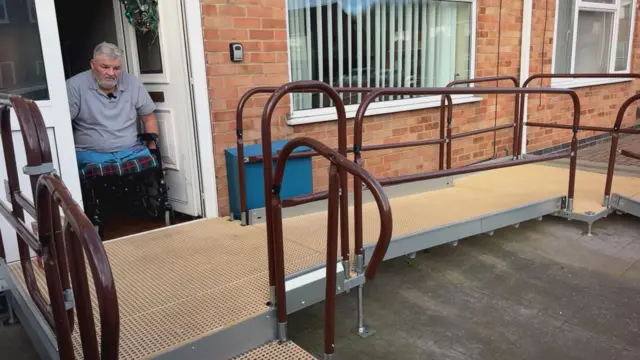
More than two years after major surgery that resulted in the loss of both legs, Neville Bradford still does not have a wheelchair that fits his body properly.

AD: Capeesh Restaurant
His ordeal has drawn attention to long waiting lists, service backlogs and the human cost of delays in wheelchair services across the country.
Bradford’s experience began in October 2023 when peripheral arterial disease led to the amputation of both legs. After months in hospital, he was discharged with two basic manual wheelchairs on loan from the Royal Derby Hospital.
Those chairs, he says, were too large and poorly suited to his needs, making it difficult or impossible to propel himself without assistance. Outside the house, he is dependent on help from a carer or family member because the equipment he has does not enable him to move unaided.

AD: Oysterian Sea Food Restaurant And Bar
While wheelchair services are intended to provide a gateway to independence and improved quality of life for people with mobility impairments, Bradford’s story underscores persistent problems within the system designed to deliver those solutions.
The bespoke wheelchair he needs, ordered through provider Blatchford Mobility under contract to the NHS Derby and Derbyshire Integrated Care Board, has been repeatedly delayed, leaving him navigating daily life with equipment that does not meet his physical requirements.
In recent years, concerns over NHS wheelchair services have gained wider scrutiny. Data collection introduced by NHS England aims to benchmark delivery times and improve commissioning, yet numerous reports suggest significant delays and inconsistencies remain across regions.
Bradford’s situation has not been unique. Across England, waiting times for NHS-provided wheelchairs are stretching well beyond expected targets, with new figures showing that many disabled adults and children have to wait more than four months for a chair a period that can severely limit day-to-day functioning and independence.
Advocacy groups representing people with progressive conditions highlight that delays often mean life-changing equipment is out of reach for those who need it most.
The impact of inadequate wheelchair provision extends far beyond inconvenience. For individuals like Bradford, being fitted with the wrong chair or waiting months for the correct one can lead to chronic pain, loss of confidence, reduced social participation and a profound sense of isolation.
Over time, poor seating can cause pressure sores, back problems and additional health complications outcomes that may require further treatment and reduce quality of life.
While the NHS constitution pledges an 18-week maximum wait for wheelchair provision, numerous local services miss this target, contributing to a broader “postcode lottery” where the quality and timeliness of service vary significantly depending on where a patient lives.
Disability advocates and campaigners have called for a comprehensive independent review of wheelchair services in the UK to ensure accountability, transparency and uniform standards.
A petition launched earlier this year urged the government to act urgently to address delays, poor assessments and equipment unsuited to patient needs, arguing that many disabled people are being let down by an underfunded system.
In a statement responding to Bradford’s case, the NHS Derby and Derbyshire ICB acknowledged the backlog inherited when Blatchford Mobility took over the contract in April and apologised to patients who had waited longer than expected for appropriate equipment.
They noted that approximately half of those on the waiting list have now received their chairs and that work is ongoing to support remaining patients based on clinical need.
Yet for Bradford and many others, partial progress offers little solace when daily life remains constrained. The manual wheelchairs he has are “too big,” he says, leaving him unable to generate enough momentum to move himself effectively.
The repeated cancellation of his bespoke wheelchair order twice after being measured for the chair has added to frustration and feelings of neglect within a system meant to help those most in need.
Advocates emphasise that proper wheelchair fitting is not a luxury but a necessity. Wheelchairs must be individually measured and tailored to body shape, limb length and specific mobility needs. Without such bespoke features, users can struggle with propulsion, posture support and comfort, leading to secondary health issues and diminished quality of life.
Customisation is especially critical for double amputees, whose unique balance and propulsion requirements differ significantly from standard wheelchair designs.
Beyond bespoke chairs, broader systemic challenges plague wheelchair services. Reports from disability campaigners and service users highlight issues such as delayed assessments, equipment returned in poor condition, and inconsistent communication between health professionals and suppliers.
These problems have, in some cases, compelled disabled individuals to rely on crowdfunding or out-of-pocket purchases just to secure basic mobility a stopgap solution that not only highlights gaps in public provision but also deepens inequality.
The National Wheelchair Data Collection initiative reflects a step toward understanding the scale of the problem by gathering transparent data on waiting times and outcomes. Healthcare planners hope this information will drive improvement and accountability.
However, critics argue that data alone is not enough; structural reforms and investment in service capacity are necessary to ensure disabled people receive timely, appropriate equipment that allows them to participate fully in daily life.
For Bradford, the delay has had tangible consequences. Without a wheelchair that fits, he must rely on carers to push him when leaving the house. Simple outings involve careful planning and assistance, curtailing spontaneity and independence.
The inability to self-propel limits his engagement with community events, social meetings and even basic errands. Over time, these limitations have taken an emotional toll, compounding physical dependency with psychological strain.
His experience has prompted conversations within local disability networks about how best to hold services accountable and advocate for those waiting. Peer support groups offer solidarity, sharing stories of long waits and mismatched chairs while brainstorming ways to navigate bureaucratic hurdles.
Some have pointed to national campaigns calling for independent oversight of wheelchair services, arguing that broader recognition of these systemic shortcomings is needed at a policy level.
Despite official assurances that progress is being made in clearing backlogs, Bradford remains cautious. The promise of eventual provision does not erase the daily challenges he faces or the frustration of being caught in a system where delays are measured in months and years rather than weeks.
His case has become emblematic of a larger issue confronting disabled people across the UK one that raises questions about equity, resource allocation and what it means to ensure dignity for those with long-term mobility needs.
In the broader context of healthcare services, wheelchair provision sits at a crucial intersection of rehabilitation, independence and quality of life. For many, a wheelchair is not simply a piece of equipment but the means to access the world to work, study, socialise, and live with autonomy.
When that access is delayed or denied, the repercussions ripple outward, affecting physical health, mental well-being and community participation.
The story of Neville Bradford serves as a stark reminder that behind statistics and policy discussions are individuals whose everyday lives hinge on the timely delivery of functional, personalised mobility solutions.
Campaigners continue to urge policymakers to prioritise reforms that eliminate backlogs, standardise service quality and, critically, listen to the voices of wheelchair users themselves. Only by addressing these systemic failings can the true promise of mobility provision independence, dignity, and inclusion be realised for all who depend on it.

AD: Heritage And Restaurant Lounge Bar