
Gabriel Princewill-
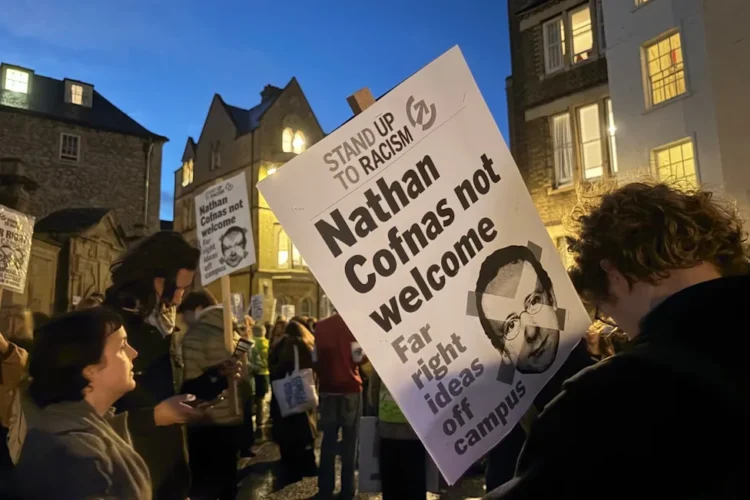
Hundreds of protesters gathered outside Oxford University’s Oriel College to oppose a controversial talk by academic Nathan Cofnas, whose accusations of plagiarism against the late Professor Jason Arday triggered weeks of intense public scrutiny and controversy. The demonstration, organised by anti-racism group Stand Up To Racism, took place on Tuesday evening ahead of Cofnas’s scheduled appearance at an event organised by Oxford Reform UK. Protesters condemned the decision to give him a platform at one of the country’s most prestigious academic institutions, arguing that his views on race and intelligence risked making students from minority backgrounds feel unwelcome and undermining the university’s commitment to equality and inclusion.
Tensions were evident outside the college as demonstrators gathered around the entrance gates, with some appearing to attempt to prevent people from entering ahead of the event. Dozens held placards bearing messages including “Nathan Cofnas not welcome” and “Remember Professor Jason Arday”, while chants of “Nathan Cofnas shut him down” could be heard. Some protesters wore face coverings as opposition to the event intensified. The demonstration reflected wider concerns about the boundaries of academic freedom and whether universities should provide platforms for speakers whose public statements have attracted allegations of racial prejudice.

AD: Capeesh Restaurant
Cofnas’s talk was entitled “Is DEI (Diversity, Equality and Inclusion) Undermining Higher Education?” However, much of the opposition centred on his previous comments about race and intelligence and his role in the plagiarism controversy involving Professor Arday. Cofnas published a blog post accusing Arday of plagiarising material in his doctoral thesis. The allegations prompted a weeks-long controversy that placed the Cambridge professor’s academic work and professional achievements under intense public scrutiny in the British media. Arday, who was 41, denied the allegations but subsequently resigned from his position as Professor of Sociology of Education at the University of Cambridge.
He was later found dead at his home in south London on 14 August. The controversy has become very divisive, with critics blaming the media of hounding the late professor too much, leading to his death. Some factions have become particularly angry after arday was said to have been cleared by John moores University and scientific publishers, Taylor and Francis. The clearance on top of the fact Cambridge Univeristy passed arday for his doctoral thesis has fuelled the anger in some quarters. Yet, the irony is that the fact Arday was cleared of plagiarism, and the University passed him, does not objectively resolve the issue of whether arday wa sindeed guilt yof plagiarism.

AD: Oysterian Sea Food Restaurant And Bar
Members of the media who investigated Arday’s thesis concluded there were too many unattibuted academic materials in his thesis, making it very contentious when advocates of Arday say any shortcomings in the late professor’s academic citings can be attributed to ‘honest errors’ , influenced by his autism. There has been no officially released information about where on the spectrum of autism Arday’s neurodiversity was, and whether it objectively mitigates the gaps in the academic citing of his thesis. The fact Cofman’s publication exposing the issues in Arday’s work and broader claims about his accomplishments has inflammed the atmosphere. Yet, the issue of the media investigating Arday’s credentials had a legitimate public interest, but is blighted by the excessive nature of its coverage, and Cofman’s backgrouynd connection to the process.
On Tuesday, protesters used the Oxford demonstration to remember Arday and challenge the decision to host the academic who made the allegations against him. Theo Biggs, a 20-year-old student at nearby Oxford Brookes University, questioned the decision to allow Cofnas to address an audience in Oxford, arguing that the institution’s international reputation gave the event wider significance.
“Oxford University is a prestigious university, and what is talked about here is talked about around the world. Giving this sort of conversation a platform is legitimising it essentially,” he said.
A university course administrator, who requested anonymity, also expressed concern about the effect of the event on students from ethnic minority backgrounds, saying some felt uncomfortable and frightened by the college’s decision to proceed. “I’ve seen a lot of students of colour are feeling unwelcome, uncomfortable, frightened by the fact that Oriel and the wider university has not shut this down,” the administrator said. Another student described feeling frustrated that their minority background appeared to have become a source of hostility despite the hard work involved in securing a university place.
“I’ve worked really hard to get here. I pay a lot of money to be here, and then me being a minority is like the biggest sin in the world. It’s not something I want, it’s not something I’m standing for at all,” the student said.
Cofnas has previously advocated what he describes as “race realism” and written controversial claims about differences in intelligence between racial groups. In previous writing, he argued that black people were less intelligent than other groups and suggested they would “disappear from almost all high-profile positions outside of sports and entertainment” under a meritocratic system.His views have attracted criticism and have become a central focus of opposition to his appearances at academic institutions. Cofnas was also suspended from Ghent University in Belgium in August before being reinstated following pressure from US ambassador Bill White. The dispute at Oriel College continued beyond Tuesday’s demonstration.
On Thursday, protesters opposed to the event placed a Ku Klux Klan hood on a controversial statue of 19th-century colonialist Cecil Rhodes at the college, bringing renewed attention to the institution’s historical associations and the wider debate over race and representation. Oriel College defended its decision to allow the talk, insisting that it had a legal responsibility to uphold freedom of expression while maintaining an inclusive environment for students and staff.In a statement, the college said it was “committed to upholding freedom of speech within the law and has a statutory duty to do so”.
It added that it was equally committed to promoting inclusion and ensuring that its environment remained free from discrimination and harassment, including racial discrimination. The college also stressed that allowing Cofnas to speak should not be interpreted as approval of his views, stating that permitting the event “does not imply endorsement by the college of the views of its speakers”. Oxford Reform UK, which organised the talk, describes itself as a society dedicated to providing a space for free speech, serious discussion and association between students linked with Reform UK.
The protest has reignited a wider debate over the responsibilities of universities when hosting controversial speakers, particularly where their public statements have raised concerns about race and discrimination. While demonstrators insist that providing a platform for such views risks legitimising prejudice, Oriel College maintains that freedom of expression within the law must be protected. The challenge facing universities remains how to uphold open academic debate while ensuring that students from all backgrounds feel respected, included and able to participate fully in university life.

AD: Heritage And Restaurant Lounge Bar