
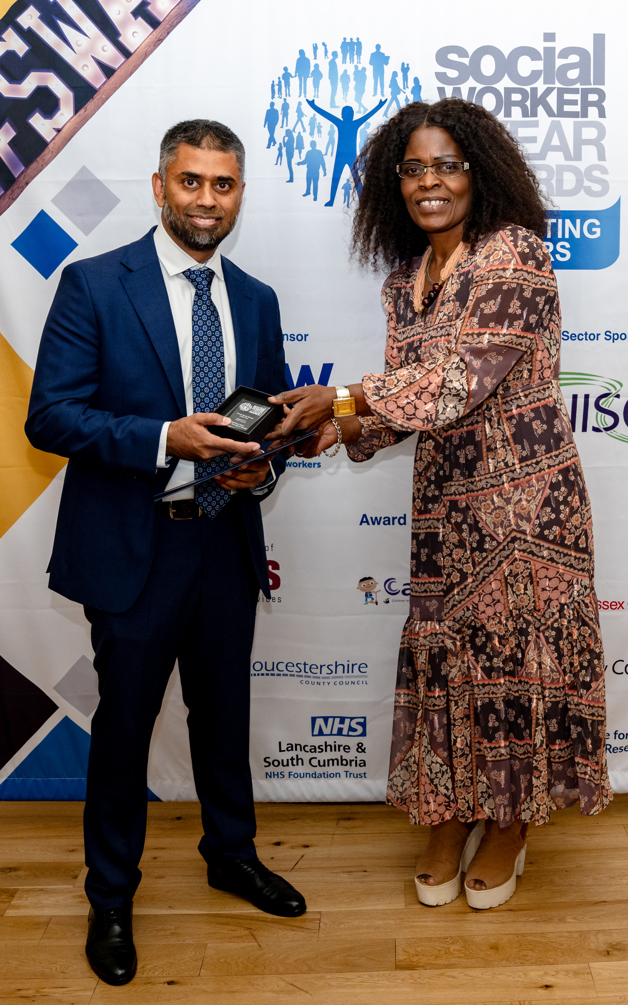
By Anji Ossai And charlotte Webster-The social work awards of the year is marking its 20th year of celebrating unsung heroes who are changing lives throughout the year in a profession too often publicised by its failures.Judges selected 64 finalists across 14 categories in August, selecting the winners from the shortlistThe awards recognise excellence in social work in England, and this year’s finalists were chosen by a panel of practitioners, leaders, previous winners, and people with lived experiences.When Mahfuzul “Maf” Khan, Director of Early Years Help in Newham (pictured) and the late Dave Fry of Croydon Council were named joint Overall Social Workers of the Year, they represented two very different points in a profession’s story.Khan was recognised for his leadership in children’s services. whilst Fry, who died before receiving the honour, was awarded the Lifetime Achievement Award in recognition of his contribution to social work.
It was a moment of celebration., but also offered an opportunity to look beyond the trophies and ask a more searching question about what two decades of recognising exceptional social work tell us about the profession, the people who depend on it and the society in which it operates?
The awards were established in 2006 by Beverley Williams, an independent social work practitioner who qualified just two years earlier. Having experienced the profession herself, she believed its demanding work and positive impact on vulnerable children, families and adults deserved greater recognition.
The annual event subsequently achieved charitable status in 2011, and Williams received an MBE in 2015 for establishing them. Twenty years later, the awards have become a national platform for celebrating achievement across social work in England, with hundreds of entries attracting attention each year.
But their anniversary arrives at a time when the distinction between celebrating individual excellence and confronting the conditions in which professionals work has rarely been more important.
A profession seen through its crises
Social work occupies an unusual place in public life. Its practitioners can be called upon to protect children from abuse, help adults live independently, support people experiencing mental ill health, challenge exploitation and help families navigate some of the most difficult periods of their lives.
Yet public attention can be dominated by cases in which something has gone catastrophically wrong. The work that succeeds is often far less visible, and may involve building trust with a family over months, persuading someone in crisis to accept support, helping a vulnerable adult regain independence or identifying a danger before it escalates.
These achievements do not always produce a dramatic headline. Sometimes success means that a crisis never happens. That makes the awards particularly interesting as a record of what the profession itself considers worth celebrating. They offer a window into work that can otherwise remain hidden behind case files, statutory duties and public controversy.

Selection of Gold winners Image: Social Worker of the Year Awards
It is not known whether recognition of outstanding practitioners can also help the public understand what effective social work actually looks like — and what it takes to deliver it. One striking feature of the awards is their recognition that social work is not simply the achievement of exceptional individuals.
A social worker may be the person a family remembers, but the outcome can depend on colleagues, managers, schools, health services, housing providers and other agencies working together.
This year’s Team of the Year award in adult services went to the Octopus Energy Social Work Team, which also featured among the previous year’s winners. In children’s services, Lewisham Council’s Integrated Adolescent Service received the 2026 award.
Attendees included senior social workers, trustees, judges, sponsors, and people working in the social work sector and friends of the awards. This means attendance is not limited to award recipients
One senior social worker at the event who insisted on anonymity, told The Eye Of Media.Com : ‘Good practice is not just about finding remarkable people. It is also about creating teams and systems in which good work can happen consistently. The award for supportive employers makes that point particularly relevant’.
However, in a profession that depends on compassion, sound judgement and the ability to build relationships, working conditions, supervision, manageable workloads and organisational culture can influence whether those qualities can flourish , and if so, the extent to which they can
The awards celebrate excellence, making the next step is to examine what the organisations behind that excellence are doing differently — and whether their lessons could be applied more widely.
A changing definition of social work
The anniversary also provides a snapshot of how the profession is responding to changing social needs. This year’s winners included ParentAssess, recognised in the Social Justice Champion category, and Dr Philip Archard, recipient of the Practitioner-Led Research Award.
The awards also recognise technology-enabled practice, alongside established areas such as mental health, adult safeguarding and children’s services. Together, these categories suggest a profession whose work extends beyond traditional perceptions of social workers intervening in family crises.
The anniversary could therefore be used to examine the winning projects of the past two decades, asking which innovations endured, which changed practice and what lessons remain underused.
Their 20th anniversary is a fitting moment to honour that achievement. But it is also an opportunity to look beyond the winners and examine the conditions that make their work possible. Because the ultimate measure of social work is not how many awards a profession gives out.