
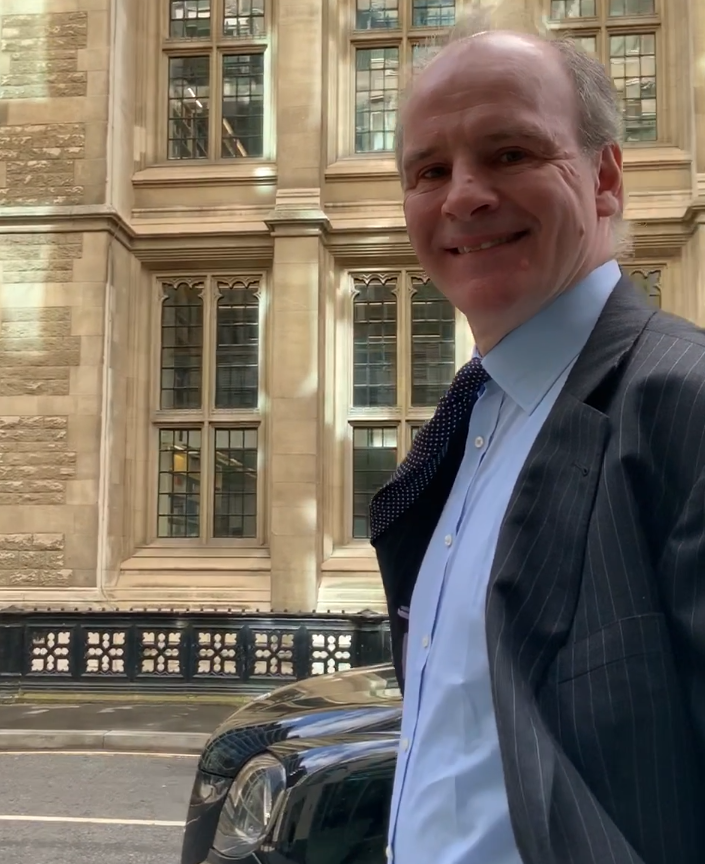
By Gabriel Priincewill-
A legal blogger who says he was bombarded with sexually suggestive messages, threatened with litigation and left frightened for the security of his home has described how a solicitor’s persistent correspondence culminated in an uninvited visit to his front door.
The evidence, heard at Snaresbrook Crown Court, has brought renewed attention to the boundaries between professional disputes, freedom of expression, and alleged harassment — and to the mechanisms available for holding members of the legal profession accountable.
Daniel Cloake, who writes the court-reporting blog Mouse in the Court, gave evidence during Andrew Jonathan Milne’s appeal against his stalking conviction. Cloake told the court that he received several emails a day over five months in 2024, describing the volume as a “tidal wave of correspondence” that left him feeling there was no escape.
Much of the material was incoherent, he said, while other messages allegedly combined threats of legal action with sexual propositions and repeated invitations to meet. Milne, a solicitor admitted to the profession in 1986, was convicted of stalking without fear at Stratford Magistrates’ Court on 10 February 2026 after a seven-day trial. He denied the offence and is now appealing the conviction before a judge and two magistrates.
The appeal is significant not only because of the allegations against an experienced legal practitioner, but also because it raises questions about how conduct that appears on the surface to be correspondence or threatened litigation can be assessed when viewed as part of a wider pattern of behaviour.
The court heard that Cloake had begun writing about Milne in 2019, when the solicitor was involved in civil litigation. Their contact remained limited until March 2024, when they encountered one another at a hearing at the Royal Courts of Justice.
Cloake accepted two invitations to lunch at the nearby Law Society Six Clerks restaurant, but said he subsequently declined further invitations and had only one brief interaction with Milne to thank him for information.
According to Cloake, the lunches marked a turning point. At the first meeting, Milne allegedly offered £5,000 for the copyright of a video recorded in 2019. At the second, the solicitor made remarks about turning Cloake into his sexual slave at weekends and suggested they should have dined at the Savoy so they could stay overnight. Cloake told the court that subsequent emails contained further sexual innuendo, offers of money and references to him as a prostitute.
The alleged correspondence also moved beyond personal remarks into matters that Cloake said made him fear for his financial security. The court heard that some messages threatened litigation and referred to the value of his home as a potential asset.
Cloake described one letter as “incredibly scary”, saying the prospect of losing his home was frightening because of the substantial sums being discussed.The case took a more unsettling turn in August 2024, when Milne allegedly attended Cloake’s home while the blogger was out. Doorbell footage was played to the court, showing Milne waiting outside for approximately nine minutes.
Cloake said a letter was subsequently left at the property containing further sexual references and claims that Milne had spoken to neighbours about the pair being in a relationship. He told the court that the references to his home and the suggestion that Milne might come there to “explore his mousehole” felt threatening.
Cloake eventually reported the matter to police after discussing the correspondence with another journalist. He also contacted the Solicitors Regulation Authority (SRA), the independent regulator responsible for overseeing solicitors in England and Wales.
His evidence that he had hoped the regulator would intervene, but received no response at the time, raises a wider question about how quickly professional concerns are identified and acted upon when allegations involve conduct outside ordinary legal practice.
There has since been a formal regulatory development. The SRA announced in July 2026 that Milne had been referred to the Solicitors Disciplinary Tribunal over allegations relating to the same period. The tribunal is independent and will consider the evidence before reaching its own decision; the regulatory allegations remain unproven.
The SRA has also imposed conditions on Milne’s practising certificate, including restrictions on practising in real property law and a requirement for supervision. These measures are separate from the criminal appeal.
The wider significance of the case lies in the difficulty of distinguishing legitimate legal correspondence from conduct that becomes oppressive when repeated, personalised and combined with unwanted contact outside professional settings.
Solicitors are entitled to pursue clients’ interests, raise legal arguments and challenge reporting they believe to be inaccurate. But the professional status of a sender does not, by itself, make every communication legitimate. The question in a stalking case is whether the conduct, considered as a whole, meets the relevant legal test — not whether each individual email or letter can be presented as an isolated act.
A striking historical comparison emerged in 2021, when far-right activist Tommy Robinson was made subject to a five-year stalking protection order after going to the home of Independent journalist Lizzie Dearden and shouting abuse.
The court heard that Robinson had obtained information about Dearden after she sought comment for a story, and had threatened to return to her address. The magistrate concluded that his behaviour had crossed the line between harassment and stalking.
The circumstances differ substantially from the Milne case, but both illustrate the risks that arise when a dispute connected to journalism moves from professional disagreement into unwanted contact at a reporter’s home.
Harassment does not have to begin with an explicit threat of physical violence to become a serious concern. Persistent unwanted messages, attempts to obtain personal information, threats involving legal or financial consequences ,and visits to a person’s home can take on a different meaning when they form part of a sustained course of conduct. That is why the sequence of events described in court, rather than any single email, is central to the case against Milne.
Cloake was due to be cross-examined by Milne’s representative as the appeal continued. The court has yet to determine the appeal, and Milne’s conviction remains subject to that process. Whatever the outcome, the proceedings have placed an uncomfortable question before the legal profession: how should the system respond when the person accused of crossing professional and personal boundaries is themselves a solicitor, familiar with the law and its procedures?
The case is therefore about more than a stream of unwanted emails. It concerns the limits of professional power, the protection of people who report on the courts and the responsibility of regulators to respond to complaints.
The ability to scrutinise legal proceedings depends on being able to do so without fear that their reporting will trigger sustained personal pressure. The appeal will determine whether Milne’s conviction stands, but the broader challenge of protecting that independence extends well beyond one courtroom.