
By Aaron Miller-
Nearly three decades after Cuban fighter jets shot down two civilian aircraft over the Florida Straits, the United States has formally indicted former Cuban President Raúl Castro, reopening one of the most painful and politically charged episodes in modern U.S.-Cuba relations.
The indictment, announced Wednesday by federal prosecutors in Miami, accuses Castro and several former Cuban military officials of murder, conspiracy to kill U.S. nationals, and destruction of aircraft in connection with the 1996 downing of planes operated by the Miami-based humanitarian group Brothers to the Rescue.

AD: Capeesh Restaurant
The move marks a dramatic escalation in Washington’s long-running confrontation with Havana and represents the first time a former Cuban head of state has faced criminal charges in a U.S. court over the deaths of American citizens.
Prosecutors allege that Castro, who was serving as Cuba’s defence minister at the time of the incident, authorised or oversaw the operation that led Cuban MiG fighter jets to destroy the unarmed Cessna aircraft on February 24, 1996. Four men were killed in the attack: Carlos Costa, Armando Alejandre Jr., Mario de la Peña, and Pablo Morales.
The announcement was made during a memorial event in Miami attended by relatives of the victims, Cuban-American activists, and Justice Department officials. Acting Attorney General Todd Blanche described the indictment as “a pursuit of accountability that has waited far too long,” adding that no foreign leader should be immune from prosecution if Americans are deliberately targeted and killed.

AD: Oysterian Sea Food Restaurant And Bar
According to court documents, U.S. prosecutors claim newly reviewed intelligence files and witness testimony strengthened the case against Castro and other officials connected to the Cuban air force command structure.
The indictment also names several former Cuban military officers accused of directly coordinating the aerial interception. One of the accused, according to U.S. officials, is already being held in federal custody on unrelated immigration charges.
The case revives international attention on the Brothers to the Rescue mission, a volunteer exile organisation formed in the early 1990s to search for Cuban migrants attempting dangerous sea crossings to Florida.
Over time, the group evolved into a highly visible anti-Castro movement, conducting flights near Cuban airspace and occasionally dropping political leaflets over Havana. Cuban authorities repeatedly accused the organisation of violating national sovereignty and attempting to destabilise the government.
International investigators later concluded that the two aircraft destroyed in 1996 were operating in international airspace when they were intercepted and shot down. A third aircraft escaped after witnessing the attack. The International Civil Aviation Organization criticized Cuba’s use of force and concluded that nonviolent alternatives had not been exhausted before the planes were destroyed.
A Diplomatic Flashpoint Returns
The indictment arrives at a moment of renewed strain between Washington and Havana. The Trump administration has intensified sanctions against Cuba in recent months, accusing the island’s communist leadership of human rights abuses, political repression, and cooperation with authoritarian allies in Venezuela and elsewhere.
Analysts say the legal action against Castro is both symbolic and strategic, aimed at increasing pressure on the Cuban government while energising anti-communist Cuban-American voters in South Florida.
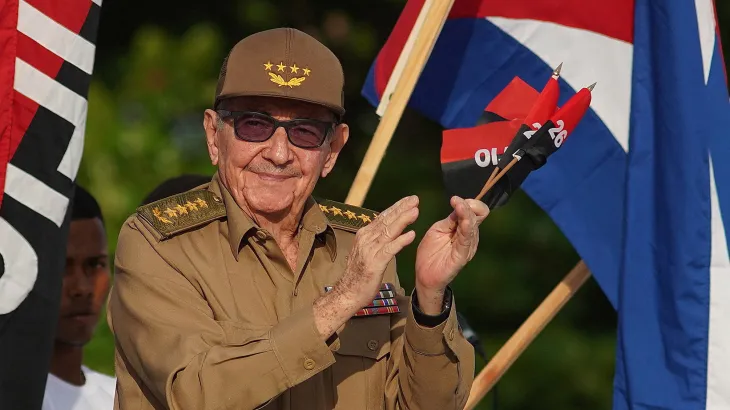
Raúl Castro, now 94, formally stepped away from political leadership in 2021 after decades at the center of Cuban power. The younger brother of revolutionary leader Fidel Castro, he served for nearly half a century as defence minister before becoming president in 2008. Though officially retired, many observers believe he still exerts influence within Cuba’s ruling Communist Party and military establishment.
Cuban officials quickly condemned the indictment, calling it politically motivated and legally illegitimate. Cuban President Miguel Díaz-Canel accused Washington of reviving Cold War hostilities and attempting to justify increased aggression toward the island. State media in Havana characterised the charges as an “imperialist fabrication” designed to interfere in Cuban internal affairs.
The legal case also highlights unresolved disputes over what exactly happened during the fatal encounter in 1996. The U.S. government and international investigators have long maintained that the planes were flying outside Cuban territorial airspace when they were destroyed.
Cuban authorities, however, insisted at the time that repeated incursions and provocative actions by Brothers to the Rescue constituted a security threat.
Despite Havana’s defense, the shootdown triggered widespread international outrage when it occurred. The United Nations Security Council condemned the use of weapons against civilian aircraft, while then-President Bill Clinton tightened the U.S. embargo against Cuba by signing the Helms-Burton Act, which significantly expanded sanctions on the communist government.
Wednesday’s indictment represents a delayed but meaningful acknowledgment of responsibility. Several relatives who attended the Miami announcement said they never expected to see a U.S. administration pursue criminal charges against Castro himself. Community leaders in South Florida described the development as historic, even if extradition remains highly unlikely.
Legal experts note that the indictment may never lead to a courtroom trial. The United States and Cuba do not maintain an extradition treaty capable of compelling Castro’s surrender, and there is little indication Havana would cooperate with any American legal proceeding involving a former national leader.
Prosecutors argue the case carries symbolic significance and establishes a formal legal record accusing the Cuban state of carrying out an unlawful attack on civilians.
The Long Shadow of 1996
The decision to pursue charges now raises questions about why previous administrations stopped short of indicting Castro directly. While several Cuban military officers were charged in U.S. courts in 2003, Washington had historically avoided direct prosecution of senior Cuban leaders, partly out of concern for diplomatic fallout and broader regional stability.
Some analysts believe the renewed focus on the case reflects changing political dynamics in Washington and Miami, where Cuban-American communities continue to wield significant electoral influence. The administration’s tougher posture toward Havana has already included expanded sanctions, travel restrictions, and accusations of Cuban involvement in regional anti-American activities.
The case may also further complicate already fragile U.S.-Latin America relations. Several regional governments have criticized what they view as Washington’s selective use of international law against political adversaries. Others, however, argue the prosecution reinforces the principle that attacks on civilians should not escape accountability because of political status or the passage of time.
Historians note that the 1996 incident occupies a unique place in post-Cold War history because it symbolised the enduring hostility between Cuba and the United States even after the collapse of the Soviet Union.
Many policymakers believed relations between the two countries might eventually thaw. Instead, the shootdown deepened mistrust and hardened attitudes on both sides of the Florida Straits.
Whether the indictment ultimately changes the political landscape in Cuba remains uncertain. Raúl Castro is unlikely ever to appear before an American judge, and the Cuban government has shown no sign of reconsidering its longstanding narrative surrounding the incident.
The case ensures that one of the deadliest confrontations between Cuba and the United States in the post-revolutionary era will once again dominate international attention.
The families of the four men killed in 1996, the legal action offers something more personal: a renewed belief that the deaths of their loved ones have not been forgotten.
Nearly thirty years later, the downing of the Brothers to the Rescue planes continues to cast a long shadow over relations between Washington and Havana a reminder that Cold War conflicts can endure long after the era that created them has passed.

AD: Heritage And Restaurant Lounge Bar