
By Aaron Miler-
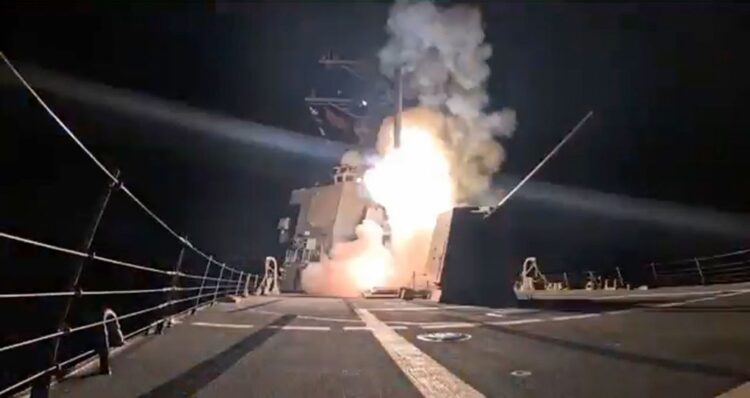
The United States launched a series of powerful and deadly military strikes against Islamic State (ISIS) militants in northwest Nigeria, President Donald Trump announced on Christmas Day, marking a significant escalation in US involvement in West African security affairs.
U.S struck 115 of IS locations in Sokoto State in Nigeria in order to forestall planned attack in Nigeria. The airstrikes, carried out in conjunction with Nigerian authorities, targeted extremist positions in Sokoto State and were described by Trump as retaliation for ongoing violence in Nigeria’s complex insurgency landscape.

AD: Capeesh Restaurant
Trump took to his social media platform on the evening of 25 December 2025 to describe the operation as a direct response to what he characterised as brutal attacks on civilian populations, particularly Christians, by ISIS affiliates in Nigeria.
Quoting the president’s online post, he said the strikes were intended to send a strong message to “ISIS Terrorist Scum” that the United States would not tolerate religiously motivated or sectarian violence. In his remarks he pledged continued pressure against extremist groups and proclaimed support for local populations targeted by militants.
Former Kogi State governorship aspirant Princess Grace Iye Adejoh saID the US strike should not be celebrated as a total victory but an indictment against Nigerian officials, Nigeria’s The Sun news outlet reported.

AD: Oysterian Sea Food Restaurant And Bar
“The current American strike on a terrorist target on Nigerian soil is a sobering reminder that our insecurity has crossed dangerous boundaries. Foreign intervention of this magnitude is not a victory; it is an indictment. It tells the world that Nigeria is struggling to contain threats from within,” Adejoh said in a statement.
She added that Nigeria, which was once celebrated as the “giant of Africa”, is now “negotiating with terror groups and relying on external forces to secure its territory”.
“This moment must serve as a national reckoning. Security is everyone’s responsibility. If Nigeria fails to confront terror from within, others will continue to do it for us – at a far greater cost to our dignity and sovereignty,” Adejoh said.
The director of the non-profit Civil Society Legislative Advocacy Centre (CISLAC) has dismissed Trump’s narrative that a strike was necessary to prevent a “slaughter” of Christians in Nigeria.
“Muslims are being killed and harassed every day by the same criminals,” Auwal Musa Rafsanjani was quoted as saying by the local Leadership news outlet. “This conversation should be about human life, not religion or geography.”
Rafsanjani said Nigerians of any religion are victims of terrorism and warned that claiming otherwise could ignite ethnic or religious tensions.
The director stressed that any intervention, local or foreign, must prioritise accuracy, accountability and protection of innocent lives. He also claimed that Nigeria’s worsening security situation was to be blamed on corruption and the government’s decades-long inability to deal decisively with armed groups.
US President Donald Trump claimed on Truth Social that the armed group had “targeted and viciously” killed “primarily, innocent Christians, at levels not seen for many years, and even Centuries!”
Nigerian Foreign Minister Yusuf Tuggar spoke to Al Jazeera and said the strike “clearly” showed that his government would work with other countries in the “fight against terrorism”.
A local media report claims to show the remnants of a US missile that landed in the village of Jabo in northwestern Nigeria’s Sokoto State.
Residents in the village of Jabo in northwestern Nigeria’s Sokoto State who spoke to Al Jazeera said the air strike did not result in any casualties.
Abdulrahman Mainasara, a Jabo resident, explained that Thursday night’s attack struck an already cultivated farmland behind a primary school at the outskirts of the village. Abulrahman visited the scene last night, took some pictures and witnessed how some locals carried debris from the scene.
“The bomb fell and burst into many pieces. There were two big pieces of debris. One of them was carried by two people,” he told Al Jazeera on Friday.
Another resident, Ismail Umar, said the community has not experienced any armed group attack in more than two years.
While armed fighters, locally known as bandits, operate in Nigeria’s northwest, their operations are mostly in the eastern part of Sokoto State and not the southern part of the state where the US attacked.
US Republican Representative Riley M Moore says the Christmas Day strike on Nigeria was the “first step to ending the slaughter of Christians and the security crisis affecting all Nigerians”.
In a post on X, responding to Defense Secretary Pete Hegseth, Moore reiterated that Trump had been clear that the “killing of Christians in Nigeria must end”.
“As I stated at the outset: Do not test President Trump’s resolved in this matter,” he wrote.
On Trump’s social media post framing the strike as a protection of Christians, Tuggar says they’re not going to “pore over the forensic details of what was said”.
“We’re focusing more on what has been done. So, there’s a difference between the ontology and the consequentialism and in this case, Nigeria is going with the consequentialism – the end justifying the means because it’s a very serious matter for us and the region,” he said.
“It’s not about religion, who said what, it’s about getting the result,” Tuggar added.
The line among the Christian Evangelical groups in the United States is that the Nigerian government has not done enough to protect Christians from attacks.
Over the past month or so, Trump has been posting on social media about it, saying that the US might come in with guns blazing if the Nigerian government didn’t do more. At the beginning of November, the State Department made Nigeria a country of concern for religious freedom.
While this narrative has been gaining support in some areas of MAGA and the Trump coalition, the State Department’s own point man in Africa, Massad Boulos, has been on the record saying that this is more complicated than that.
Boulos himself has said that more Muslims have been killed by ISIL than Christians. But now [the Trump administration is] on this narrative and perhaps we can see why that might be appealing on Christmas day to elements of the Trump base.
Nigerian Foreign Minister Yusuf Tuggar says Abuja provided the US with intelligence ahead of the Christmas Day strike.
Tuggar told the local television network ChannelsTV that he spoke with US Secretary of State Marco Rubio on the phone about the attack.
“We spoke twice. We spoke for 19 minutes before the strike and then we spoke again for another five minutes before it went on,” Tuggar explained. He added that they spoke “extensively” and that President Bola Tinubu gave “the go-ahead” to launch the strikes.
The strikes would be an “ongoing process” that would also involve other countries, he said without disclosing details.
He stressed that Nigeria’s approach to the fight against armed groups was not influenced by the religion of the victims, “whether they are Muslims or Christians, and irrespective of what type of terrorism”.
The military action, confirmed by US Africa Command (AFRICOM), involved precision strikes on militant strongholds in Sokoto State after intelligence sharing with the Nigerian government, which emphasised that the operations formed part of longstanding security cooperation to confront violent extremist threats.
Nigeria’s Foreign Affairs Ministry issued a statement acknowledging coordinated operations with international partners, including the United States, to address the persistent threats posed by terrorism and violent extremism.
While agreeing on the need to confront extremist violence, Nigerian officials also emphasised that the country’s security challenges affect both Christian and Muslim communities, underscoring the multifaceted nature of violence in the region.
A Christmas Offensive and Broader Security Context
The timing of the strikes on Christmas Day drew global attention. Trump’s announcement framed the intervention as a protective measure against what he described as heightened persecution of Christian communities in Nigeria, a deeply religiously and ethnically diverse nation.
Analysts note that although some extremist violence in Nigeria has targeted Christian institutions and congregations, the broader security situation includes attacks on multiple communities and is driven by a web of complex local, economic, and ideological factors.
The US strikes in Nigeria represent one of the most visible manifestations of Trump’s increasingly assertive foreign policy approach toward violent extremist groups. Earlier in December, Washington authorised other operations against Islamic State affiliates in the Middle East, reflecting a broader return to kinetic action against terrorist organisations following a period of relative drawdown of direct military engagements in the region.
Trump’s decision to launch the Nigeria operation follows months of public warnings and diplomatic pressure on Abuja. In preceding weeks he had repeatedly criticised the Nigerian government’s response to sectarian violence and had even threatened to curb US aid and consider direct military action if improvements were not seen.
These public statements, made on social media and during political rallies, were seen by some as reinforcing a narrative of religious persecution that has been controversial among analysts who argue that the security picture in Nigeria is far broader than sectarian targeting alone.
Nigeria has faced years of insurgency from multiple armed groups. Among them are affiliates of the Islamic State West Africa Province (ISWAP), an offshoot of Boko Haram, and smaller factions such as the Lakurawa group, which operate primarily in remote border regions.
These groups have engaged in kidnappings, attacks on villages, and confrontations with government forces, contributing to ongoing instability especially in the northeast and northwest of the country.
Despite persistent efforts by the Nigerian Armed Forces, military capacity remains stretched across multiple fronts, as the government juggles insurgency, banditry, communal clashes, and resource competition.
Nigeria’s 2025 security budget included significant allocations aimed at combating terrorism and augmenting local military recruitment, but analysts say structural issues such as governance deficits and socio-economic marginalisation underpin much of the ongoing violence.
Trump’s offensive underscores the strengthening of bilateral military ties between the United States and Nigeria. Officials in Abuja highlighted that the strikes did not contravene Nigerian sovereignty and were part of a broader partnership that includes intelligence exchange, logistical coordination, and counterterrorism training initiatives.
The collaboration traces back to years of cooperative efforts under previous US administrations, although recent rhetoric has made the alliance more publicly visible.
The designation of Nigeria as a “Country of Particular Concern” under the International Religious Freedom Act earlier in 2025 had already signalled Washington’s intensifying focus on Nigeria’s religious and security dynamics.
That designation opened the door to visa restrictions and other punitive measures aimed at individuals or entities linked to violence against religious communities, further setting the stage for heightened diplomatic engagement.
Reactions and Regional Implications
Government spokespersons stressed the importance of tackling root causes such as unemployment, poverty, and local grievances that fuel recruitment and insurgency.
Security experts caution that airstrikes, while serving as tactical blows against militant infrastructure, are unlikely on their own to resolve deeply entrenched insurgent activity.
Analysts argue that comprehensive strategies incorporating socio-economic development, community engagement, and strengthened governance are essential to achieve lasting security gains in Nigeria’s volatile regions.
International observers also underscored the carefully calibrated diplomatic messaging surrounding the operation. Western allies generally welcomed efforts to counter violent extremism, but some stressed that framing interventions primarily around religious narratives could risk misrepresenting the complex reality of multi-faith violence and communal conflict in Nigeria.
Human rights organisations have called for transparency in reporting the outcomes of such strikes, including civilian impact assessments. Given Nigeria’s history of overlapping conflict drivers including farmer-herder clashes, separatist movements and criminal violence clarity on militant affiliations and post-strike consequences remains crucial to shaping public understanding and policy responses.
But the operation also raises concerns about the future extent of US military involvement in Africa, an area where US participation has changed recently due to shifting geopolitical objectives and strategic recalibrations.
Trump’s decision to strikes on Christmas Day has positioned the operation as both a symbolic and strategic statement in the broader fight against global Islamist militants part of a pattern of US military actions that continue to shape geopolitics and security dynamics at the close of 2025.

AD: Heritage And Restaurant Lounge Bar