
By Aaron Miller-
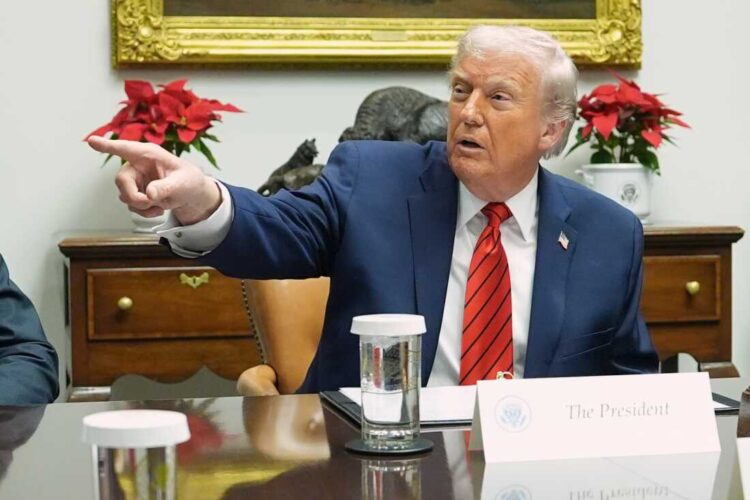
In a dramatic escalation of tensions between the United States and Venezuela, President Donald Trump announced on Tuesday that he is imposing a “total and complete blockade” on all sanctioned oil tankers entering or departing Venezuelan waters.
The unprecedented directive, proclaimed in a Truth Social post late Tuesday night, targets the country’s lifeblood its oil exports and marks a significant intensification of the U.S. campaign against Venezuelan President Nicolás Maduro.

AD: Capeesh Restaurant
Trump’s announcement comes against a backdrop of heightened military activity in the Caribbean and mounting economic pressures on the Venezuelan government. U.S. forces recently seized a sanctioned oil tanker off Venezuela’s coast, an action authorities say was aimed at disrupting illicit oil shipments linked to Maduro’s regime and other sanctioned entities.
America’s New Oil Strategy
In his social media statement, President Trump accused Maduro’s government of using oil revenues to finance criminal enterprises, including drug trafficking and human smuggling, and branded the Venezuelan leadership a “foreign terrorist organisation.” He framed the blockade as necessary until Caracas returns what he claims are U.S. “stolen” assets, including oil, land and other resources.

AD: Oysterian Sea Food Restaurant And Bar
Trump wrote that Venezuela is “completely surrounded by the largest Armada ever assembled in the History of South America,” adding that the military presence would only grow until the demands are met.
While the directive specifically mentions sanctioned oil tankers, experts have raised questions about how such a blockade will be executed and what legal authority the president is invoking for a measure that resembles a military action.
The United States has positioned nearly a dozen warships, including an aircraft carrier and amphibious assault ships, in the region alongside maritime patrol aircraft and other assets. These forces, officials say, will support enforcement of the blockade and broader operations aimed at curbing drug trafficking at sea though critics see this posture as an escalation toward direct confrontation.
Energy markets reacted quickly to the blockade announcement. U.S. crude futures climbed more than 1% as investors anticipated potential disruptions to Venezuela’s oil exports, even though only tankers on U.S. sanctions lists are currently targeted.
Industry analysts note that Venezuelan oil, already sidelined from most global markets under long-standing U.S. sanctions, still accounts for hundreds of thousands of barrels per day of crude shipments, largely to China and, to a lesser extent, to U.S. refineries via exemptions.
Francisco Monaldi, an energy expert at Rice University, explained that roughly 850,000 of Venezuela’s approximately 1 million barrels per day of oil output are exported, primarily to China, followed by a smaller share going to the U.S. under licensed arrangements.
The impact of a strict blockade, he suggests, could tighten an already constrained supply network, with ripple effects in global markets.
Diplomatic and Legal Storm
Venezuela’s government swiftly condemned the U.S. blockade, calling it a violation of international law, free navigation principles and an explicit threat to national sovereignty. Caracas said Trump’s demands reflect a belief that Venezuelan oil and mineral wealth are the property of the United States and vowed to take the matter before the United Nations.
Legal scholars caution that blockades are traditionally instruments of war under international law, and their use outside an officially declared conflict raises complex questions about presidential authority and congressional oversight.
Elena Chachko, an international law expert at UC Berkeley, noted that while U.S. presidents have broad latitude in deploying military forces abroad, a blockade constitutes a significant departure from routine enforcement of economic sanctions.
The U.S. military campaign in the region has already drawn bipartisan scrutiny within Congress, with some lawmakers arguing it exceeds legal bounds and others expressing concern that it could entangle American forces in an unwanted conflict.
Domestic critics also warn that prolonged tension may jeopardize U.S. relations with other Latin American governments and complicate diplomatic efforts to address drug trafficking and migration issues.
The Venezuelan economy, heavily reliant on oil revenue, has endured years of contraction, hyperinflation and shortages of basic goods. The blockade threatens to deepen these hardships by choking off critical export streams, potentially reducing foreign currency inflows that are essential for importing food, medicine and other necessities.
State-owned Petróleos de Venezuela SA (PDVSA) has partnered with foreign firms such as Chevron under U.S. licenses to maintain a trickle of production and exports, but the intensification of enforcement measures could jeopardise these arrangements.
PDVSA’s exports have already been squeezed by years of mismanagement, sanctions and reliance on a “shadow fleet” of tankers that evade detection and restrictions.
Even before the blockade declaration, U.S. military operations included a series of strikes on vessels in the Caribbean and eastern Pacific, which Washington has described as anti-drug trafficking actions.
Venezuelan authorities and independent observers have criticised these strikes, which have reportedly killed dozens of people, as disproportionate and outside the bounds of lawful engagement.
Latin American governments are watching the situation closely. Some regional powers have long opposed U.S. sanctions on Venezuela, advocating engagement over isolation, while others have taken a harder line against Maduro’s government.
The blockade’s broader implications for regional security, trade routes and diplomatic alignments remain uncertain, with potential for both cooperation and confrontation among neighboring states.
International law experts, diplomats and market strategists alike emphasise that the coming days will be critical in determining how the blockade is enforced, how Venezuela responds, and whether this episode marks a turning point in U.S.-Venezuela relations or the beginning of a prolonged confrontation with far-reaching consequences.
President Trump’s declaration of a blockade on sanctioned Venezuelan oil tankers represents one of the most forceful U.S. actions against Caracas in years. By directly targeting the economic engine of one of America’s most contentious geopolitical adversaries, the move has ignited legal debate, market volatility, and diplomatic turmoil.
With uncertainty about enforcement and international pushback mounting, the world watches as this fraught standoff unfolds.

AD: Heritage And Restaurant Lounge Bar