
By Sammy Jones-
Across the United Kingdom tonight and in recent days, stargazers and casual sky watchers alike have been treated to a rare and dramatic celestial display as the Northern Lights, also known as the aurora borealis, have been visible far beyond their usual northern haunts.
Normally confined to the Scottish Highlands and remote parts of northern England, these luminous waves of colour have been spotted in locations across Northern Ireland, Wales and even parts of southern England, thrilling photographers and prompting a surge of interest in the night sky.

AD: Capeesh Restaurant
The aurora borealis is caused when charged particles from the Sun collide with Earth’s magnetic field and upper atmosphere, illuminating the sky with hues ranging from green and pink to red, blue and violet. Generally, the nearer you are to the magnetic poles, the more probable it is to see these colours dancing above the horizon.
Yet under unusual boosts of solar activity such as powerful bursts of solar wind or coronal mass ejections the auroral zone can expand significantly, permitting displays much further south than usual.
Reports over the past week show that rich veils of light have been captured in places that would normally have to wait years for such a sight.

AD: Oysterian Sea Food Restaurant And Bar
Enthusiasts in Ballycastle in County Antrim, Northern Ireland have shared images of brilliant ribbons of red and green curling over local landscapes, while social media feeds have carried photos of the aurora glowing across skies in central and southern Britain a testament to the exceptional nature of this display.
Across Ireland and the UK, the Northern Lights have painted the night with contrasting hues and patterns that have electrified amateur photographers and scientists alike.
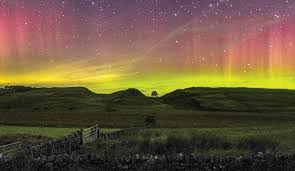
In Northern Ireland, photographers reported dramatic displays above Ballycastle with bright green and red bands spreading across the sky, leaving trails of colour that seemed almost tangible to those standing beneath.
Any seasoned sky watcher will tell you, the Northern Lights are more likely to reveal themselves during periods of increased space weather activity, especially when the Sun expels a stream of energetic particles that push against Earth’s magnetic shield.
The Met Office explains that while the UK sits south of the auroral oval a ring encircling Earth’s geomagnetic poles where aurorae are most common strong geomagnetic storms can push that luminous zone further southward, offering a rare chance for viewers in the UK to witness the spectacle in full force.
Scotland has seen many spectacular nights. In regions known for their dark skies, such as the Highlands and the Isles of Skye, the lights have bathed ancient lochs and dramatic mountain ridges in a soft glow, offering scenes that combine the brilliance of natural light with the rugged beauty of the landscape.
While aurora sightings are less rare there than in other parts of the UK, the present series of appearances has been notable for both intensity and geographic spread.
Yet it has not stopped at the traditional northern reaches. Sightings have also been logged further south, with amateur sky watchers in Wales and even parts of England sharing photos that show green ribbons of light rippling across the horizon above relatively urban areas. Such sightings, while still dependent on clear skies and low light pollution, reflect the unusual strength of the auroral activity of late.
Many who have made the effort to step outside after dark note that conditions must align perfectly to catch the lights. The skies need to be clear and free of cloud cover, and light pollution from towns and cities must be minimal to allow faint glows to emerge.
For those who have succeeded in finding the perfect vantage points, the reward has been unforgettable: skies transitioning from deep violet to shimmering green, then fading into subtle pink bands that seem to hover above the horizon like cosmic brushstrokes.
At the heart of these dramatic displays lies the Sun — our nearest star and a dynamic, ever‑changing source of charged particles. The phenomenon behind aurorae begins when a solar wind or solar storm interacts with Earth’s magnetic field, directing streams of particles toward the poles. When these particles collide with molecules in our atmosphere, light is released, creating the ribbon‑like displays commonly referred to as the Northern Lights.
Yet not all solar storms are created equal. The most dramatic aurora borealis shows occur when the Sun emits a coronal mass ejection, a potent expulsion of magnetic fields and electrically charged matter. These immense bursts can buffet Earth’s magnetosphere, energising the system to a degree that extends auroral visibility far beyond typical northern latitudes.
During periods of heightened solar activity, such as those associated with the solar maximum of the solar cycle, coronal mass ejections become more frequent and intense. While the current solar cycle is now declining from its peak, remnants of strong activity still send bursts of energy Earthward that can produce wondrous effects in the night sky.
For sky watchers and historians of astronomical phenomena, the current series of northern lights offers a reminder that nature can still surprise and enthral. In years past, similar events have graced the night sky in unexpected places. For example, aurorae once reached as far south as Cornwall and Kent, offering breathtaking visuals to observers traditionally unaccustomed to such sights. These historical moments are often etched into local lore and photographic archives, preserving memories of nature’s brush with the everyday world. The Standard
In many ways, the contemporary spectacle has brought communities together. In cities and small towns alike, neighbours are heading outdoors after sunset, phones in hand, sharing stories of sky views and capturing images to send to friends and family. Social platforms are now filled with posts tagged with photogenic aurora skies, each image a reminder of the strange and beautiful connections that can occur between Earth and the cosmos.
Onlookers often note that seeing the lights in a region like the UK — especially in places far from the usual northern hotspots — feels like gaining privileged access to one of nature’s greatest performances. People who have lived their entire lives without glimpsing the aurora describe a sense of wonder that transcends the science behind it; for many it is a moment of awe, a reminder of humanity’s small place within a vast, living universe.
Astronomers and space weather enthusiasts encourage anyone hoping to witness the lights to make use of up‑to‑date alerts and forecasting tools that track geomagnetic activity. Alerts from networks such as AuroraWatch UK can indicate when activity levels reach thresholds that make sightings likely, offering a real‑time heads‑up for those ready to step outside and look upward.
For now, the aurora borealis continues to grace UK skies unpredictably. Whether you are in the Highlands on a cold winter night or standing in a rural field in southern England, there is at least a chance that a streak of emerald or violet might appear overhead, transforming a quiet evening into an extraordinary experience.

AD: Heritage And Restaurant Lounge Bar