
By Gabriel Princewill-
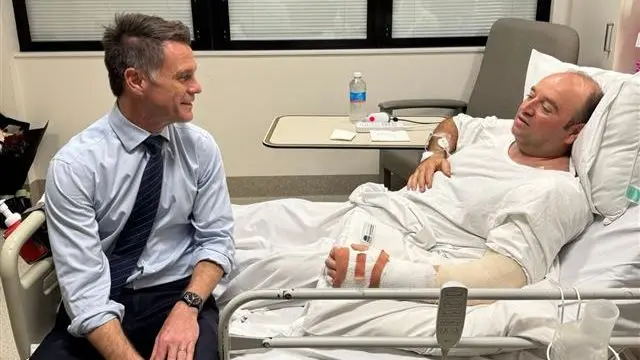
This is the picture of 43 year old Muslim hero, Ahmed al Ahmed, lying in a hospital bed after displaying an angelic energy by rising to the defence of others. He unarguably deserves the accolade of being hero of the year in Australia. His selfless act of bravery is remarkable; the spontaneous move to save other puts him on a high pedastal.
Amid the horror and chaos of a terrorist shooting at a Hanukkah celebration on Bondi Beach, one act of courage has captured the world’s attention and embodied the profound impact a single individual can have in the face of senseless violence. His outstanding spirit of special intervention will spread afar beyond his generation; his descendants will hear and tell this remarkable story.

AD: Capeesh Restaurant
Ahmed rushed toward danger as gunfire erupted, tackled an armed attacker and wrestled away his weapon. His extraordinary intervention, carried out without any combat or weapons training, is widely credited with saving multiple lives during one of the deadliest mass shootings in Australia in nearly three decades.
The horrific attack unfolded just after sunset on 14 December 2025, when gunmen opened fire on a large crowd gathered to mark the first night of Hanukkah, the Jewish festival of lights. At least 16 people were killed and dozens more wounded, including families and children who had come together in joy and celebration.Police later declared the incident a terrorist act targeting the Jewish community.
In harrowing footage that quickly spread across social media, al Ahmed is seen crouched behind a vehicle before bravely charging toward one of the armed attackers. With sheer physical determination, he confronted the gunman, seized the rifle from his grasp and forced the attacker to flee toward an area where a second gunman was firing.

AD: Oysterian Sea Food Restaurant And Bar
In doing so, al Ahmed removed one of the active threats to the crowd an action that many observers say prevented further carnage. Al Ahmed was shot twice during the struggle, sustaining serious wounds to his arm and hand. He was rushed to hospital, where he underwent surgery and was reported to be in critical but stable condition at a local Sydney facility.
Relatives and community members have spoken to journalists about his courage, describing him as a devoted father of two whose instinctive decision to act came at great personal risk.
Courage That Transcends Divisions
Reactions to al Ahmed’s actions have poured in not only from across Australia but around the world. New South Wales Premier Chris Minns hailed the intervention as “the most unbelievable scene I’ve ever seen,” noting that many lives were likely spared by his bravery.
Prime Minister Anthony Albanese echoed these sentiments, publicly praising those who “ran toward danger to help others” during the attack.
International leaders also acknowledged the significance of al Ahmed’s deed. Israeli Prime Minister Benjamin Netanyahu observed that the brave bystander who stopped one of the attackers was Muslim, extending his respect for actions that saved innocent Jewish lives.
These remarks came amid broader discussions about unity in response to acts of terror and the need to reject hatred in all its forms. What makes al Ahmed’s heroism particularly resonant for many observers is its defiance of widely held assumptions and prejudices. In public discourse surrounding Middle East politics, there are pervasive narratives that a Muslim in the West especially during a period of conflict between Israel and Hamas might harbor antipathy toward Jewish people or align politically against them.
Yet, here was a man who not only confronted a gunman targeting a Jewish celebration but placed himself directly in harm’s way to protect strangers. His actions challenged stereotypes and underscored the universality of compassion in moments of crisis.
Al Ahmed’s courage has sparked conversations about how individual acts of selflessness can bridge divides and inspire broader communities. Muslim leaders in Australia and abroad have emphasised that his actions reflect core teachings of compassion and protection of life, values shared across many faiths.
The Australian National Imams Council released a statement condemning the violence and affirming solidarity with the victims and all who were present at the celebration, expressing grief and unity with the Jewish community.
Community members have described al Ahmed as a quiet and humble figure, known in his local Sutherland Shire neighbourhood south of Sydney as a dedicated family man and small business owner. Relatives told media that he had no experience with firearms and was not affiliated with any official security role; his courage came from a visceral response to seeing innocent people at risk.
His cousin recounted to reporters that al Ahmed told family members he simply could not stand by while people were being harmed, demonstrating the universal impulse to protect others, even at great cost.
Within Australia, the response to the news has been one of profound respect mixed with sadness over the horrific loss of life at what was meant to be a peaceful holiday gathering. Public vigils and memorials have been organised in Sydney and beyond, where speakers have drawn attention to the need for unity, empathy and resilience in the face of violent extremism.
Leaders from diverse communities Jewish, Muslim, Christian and secular have come together to honour victims and celebrate the acts of bravery displayed by civilians and law enforcement alike.
Experts in social cohesion and public safety have highlighted how incidents like this underscore the importance of solidarity among different cultural and religious groups. They emphasise that heroes emerge not from collective identities but from individual choices to act with empathy and courage.
In a global climate where identity politics can fuel division, al Ahmed’s intervention has been spotlighted as a striking instance of shared humanity transcending boundaries.
Social media has further amplified these themes, with posts and commentary noting not only the bravery of al Ahmed but also the broader significance of his actions against the backdrop of polarising narratives.
Many users have framed the story as a reminder that everyday people of all backgrounds can be powerful advocates for peace and protectors of human dignity, regardless of the circumstances.Despite his injuries, support for al Ahmed has continued to grow. Messages wishing him a full recovery have come from political leaders, religious figures and ordinary citizens. There has also been public discussion about how he might be formally recognised for his courage, with calls from various quarters for official honours that affirm the value of his selfless deed.
Amid the grief over lives lost and families shattered, al Ahmed’s moment of valor offers a poignant example of resilience and altruism. It stands in stark contrast to the brutality of the attack and serves as a testament to the capacity for goodness even in the darkest moments.
His choice to confront violence with courage especially when protected by no uniform or training speaks powerfully to the potential for individuals to shape outcomes in moments that test the very fabric of society.
His actions have reignited conversations about community cohesion, the role of bystanders in emergencies, and how ordinary citizens can respond when confronted with extraordinary danger. The global response suggests that the impact of his bravery will extend far beyond the streets of Sydney, resonating in discussions about courage and compassion in communities worldwide.
Ahmed al Ahmed is a symbol of human solidarity and hope. His humanity defied expectations and restored some trust in the goodness of humanity, and confirms to the world that heroes can come from any background when the need to defend life demands action.

AD: Heritage And Restaurant Lounge Bar