
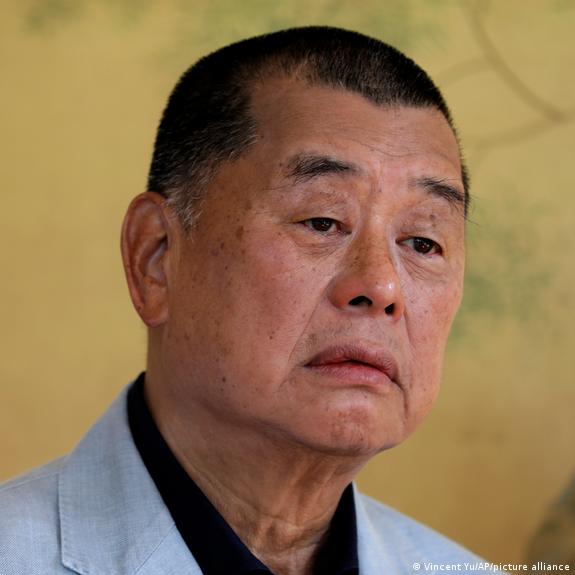
By Gabriel Princewill-
The conviction of pro-democracy media tycoon Jimmy Lai in Hong Kong has ignited a global dispute over the integrity of the legal process and the integrity of the rule of law in the former British colony.
Lai, 78, founder of the now-closed Apple Daily, was found guilty on multiple national security charges, including conspiracy to collude with foreign forces and conspiracy to publish seditious material against the Hong Kong government.

AD: Capeesh Restaurant
The conviction, which could result in a life sentence next month, has drawn fierce criticism from Human rights groups, Western governments, and international legal observers, all of whom argue that the proceedings highlight a broader erosion of judicial independence and legal norms in Hong Kong.
At the same time, Hong Kong authorities and its allied voices portray the verdict as a lawful application of existing statutes to safeguard national security.
As a British national and prominent critic of Beijing’s policies, Lai’s prosecution under the Beijing-imposed National Security Law (NSL) has been one of the most closely watched legal developments in Hong Kong since the law’s implementation in mid-2020.

AD: Oysterian Sea Food Restaurant And Bar
Officials charged Lai with conspiracy to commit “collusion with foreign forces”, based on his comments, meetings with international actors, and editorial stances linked to lobbying for sanctions and foreign pressure on Chinese and Hong Kong authorities.
Prosecutors also pursued a sedition charge under the local Crimes Ordinance related to his publication activities. Judges in the Hong Kong High Court found him guilty on all counts after a trial that stretched more than two years.
Supporters of the conviction argue that Hong Kong’s legal framework including the NSL was legitimately enacted to address security threats and that the court adhered to the letter of the law. Government representatives have described the judgment as an assertion of justice and a firm defence of the city’s legal order.
They maintain that statutes such as the NSL and sedition provisions clearly define prohibited conduct and that the judiciary reviewed evidence accordingly, irrespective of Lai’s political stature. Contrary views offered by some local legal groups emphasise trust in the overall judicial system and reject external portrayals of the trial as inherently flawed.
Yet, there have been several legitimate questions about the lack of adherence to due process in this case. The rule of law encompasses principles such as legal certainty, equality before the law, procedural fairness, access to an independent judiciary, and respect for fundamental rights like freedom of speech and fair trial guarantees. Critics of Lai’s conviction argue that several elements of his trial infringed on these principles, raising questions about whether the process met international standards.
Human Rights Watch, Amnesty International, the Committee to Protect Journalists (CPJ), and other watchdogs have issued strong statements denouncing the trial as a miscarriage of justice that undermines both press freedom and legal norms.
They describe the charges as “bogus” and the verdict as a travesty, turning peaceful expression and advocacy into criminal conduct incompatible with rights protections provided under Hong Kong’s Basic Law the city’s de facto constitution which incorporates the International Covenant on Civil and Political Rights.
One central critique centres on procedural fairness. Critics note that Lai was denied bail early in the process, diverging sharply from general legal presumptions favouring release pending trial. The city’s highest court ruled that national security cases are exceptions to typical bail norms, leaving him in prolonged pre-trial detention. Critics are adamant that his prosecution was politically motivated.
Advocacy groups also highlighted restrictions on his legal representation, including a government prohibition on his chosen British counsel and reported limitations on consular access, potentially contravening established legal protections.
Reported prolonged solitary confinement and deteriorating health conditions have further fuelled claims that the treatment afforded to Lai hindered his ability to participate meaningfully in his defence.
Another point of contention is the use of pre-NSL evidence and broad statutory interpretations. Lai’s alleged activities, including published commentary and meetings with foreign figures, span periods before the national security statute took effect.
Opponents argue that applying the law retrospectively or interpreting its scope to criminalise a publisher’s regular editorial and advocacy activities erodes legal certainty, a core component of the rule of law that holds individuals should not face criminal liability under unclear or retroactive provisions.
Concerns have been amplified by the inclusion of sedition charges under colonial-era law, which critics contend overlay additional ambiguity onto an already expansive security regime.
Moreover, the trial’s absence of a jury, replaced with a panel of hand-picked judges designated for national security cases, has drawn scrutiny. In common-law jurisdictions, jury trials are traditionally seen as a safeguard against potential judicial bias and an important procedural right.
The decision to constrain Lai’s trial within a judge-only framework has been criticised for limiting community participation in assessing contested facts and for reinforcing perceptions of a judiciary under political pressure.
International reactions to Lai’s conviction have been largely critical, with Western governments and multilateral institutions explicitly citing concerns about erosion of judicial independence. The United Kingdom government condemned the prosecution as politically motivated, asserting that Lai’s right to freedom of expression was targeted by authorities.
The European Union similarly deplored the verdict, emphasising that Hong Kong’s success as an international business hub historically rested on confidence in the rule of law a confidence they say is undermined by national security trials such as Lai’s.
These official positions underscore fears that fundamental legal protections are being subordinated to political objectives, eroding Hong Kong’s distinct legal identity under the Sino-British Joint Declaration and its own constitutional framework.
Advocacy organisations argue that punishing journalistic work and peaceful political engagement under national security charges represents a shift from lawful restraint of legitimate security threats into suppression of dissent. Amnesty International stated that the conviction sounds a “death knell” for press freedom in a city once renowned for open media and robust legal protections.
The CPJ labelled the court’s decision a “sham conviction” and called for immediate release, contending that criminalising journalism sets a dangerous precedent where critical voices are removed from public discourse through legal coercion.
Defenders of the Hong Kong legal process, including some local legal associations and government spokespeople, insist that criticisms misunderstand the legal context. They argue that laws governing national security are legitimate and necessary measures to protect public order and sovereignty, and that courts have applied them within structured legal frameworks.
These voices emphasise judicial independence in hearing the case and reject external interference or assessments that equate political disagreement with legal error. They contend that the judiciary’s adherence to procedural requirements, even in high-profile cases, demonstrates the continued operation of rule-based justice rather than arbitrary decision-making.
Whether Lai’s conviction aligns with the rule of law ultimately depends on how one interprets the balance between state authority and individual rights, and how firmly legal processes are insulated from political influence. In liberal democracies, the rule of law is tightly bound to protection of civil liberties, including freedom of expression and the press, alongside robust procedural safeguards.
When legal systems permit broad charges like those brought against Lai and when procedural norms such as bail or defence choice are curtailed, doubts arise about whether justice is administered in a manner that treats all individuals equally and without undue influence.
As Lai prepares to appeal the conviction scheduled to begin in early 2026 debates about the rule of law in Hong Kong are likely to intensify.
His case has become a symbol of wider concerns about the city’s legal and political trajectory, intersecting with questions about the independence of courts, the scope of national security legislation, and the future of fundamental freedoms once enshrined under Hong Kong’s legal charter.
Observers both inside Hong Kong and around the world will scrutinise whether appeals and judicial reviews uphold rigorous legal standards or further entrench expanded statutory interpretations that critics argue weaken traditional protections. Jimmy Lai’s conviction is not merely a legal outcome but a touchstone in a broader struggle over rule of law principles in a changing political landscape.
How the courtroom navigates the tension between enforcing national security and safeguarding civil liberties will have lasting implications for Hong Kong’s judiciary, public confidence in legal institutions, and global perceptions of justice in jurisdictions where law and politics converge.
This week, leaders of the G7 called for his immediate release.

AD: Heritage And Restaurant Lounge Bar